◈ What's in it
Nine sections, forty-plus worksheets.
Worked against one real property from beginning to end — yours, if you have it.
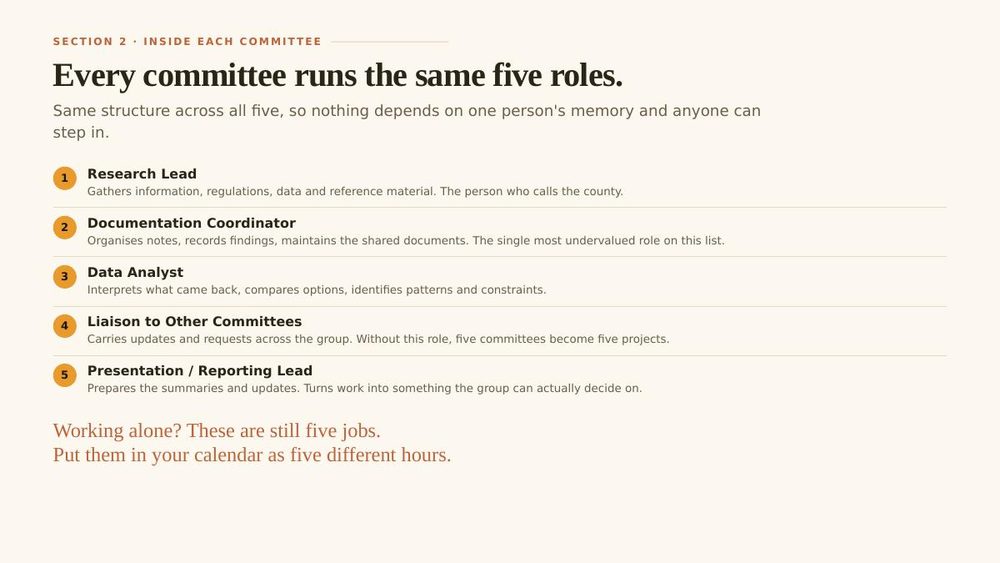
01The five committees
Development & Engineering, Governance & Compliance, Finance & Funding, Infrastructure & Operations, Community Life & Logistics — and the five roles inside each.
Org worksheetRole cards
02Legal review and sequencing
What has to happen before what. The order is not obvious, and getting it wrong costs months.
Sequence map
03Site assessment
Reading the land itself — slope, drainage, soils, access, what is buildable and what only looks buildable.
Site survey sheet
04Functional land zoning
Dividing the ground by purpose, and which zones must sit near or far from each other. The well and the drainfield are the obvious pair; there are others.
Zone adjacencyDesigner
05Subdivision and lot layout
How many lots the ground can carry, frontage and depth, the road pattern, and what the county will and won't approve.
Layout worksheet
06Water, septic and power
Feasibility first, cost second. What the developer builds versus what the buyer builds — which is the distinction that decides whether lots are affordable.
Infrastructure budget
07Roads, access and maintenance
Standards, cost per foot, who maintains it afterwards, and how that gets written into the ownership.
Road costing
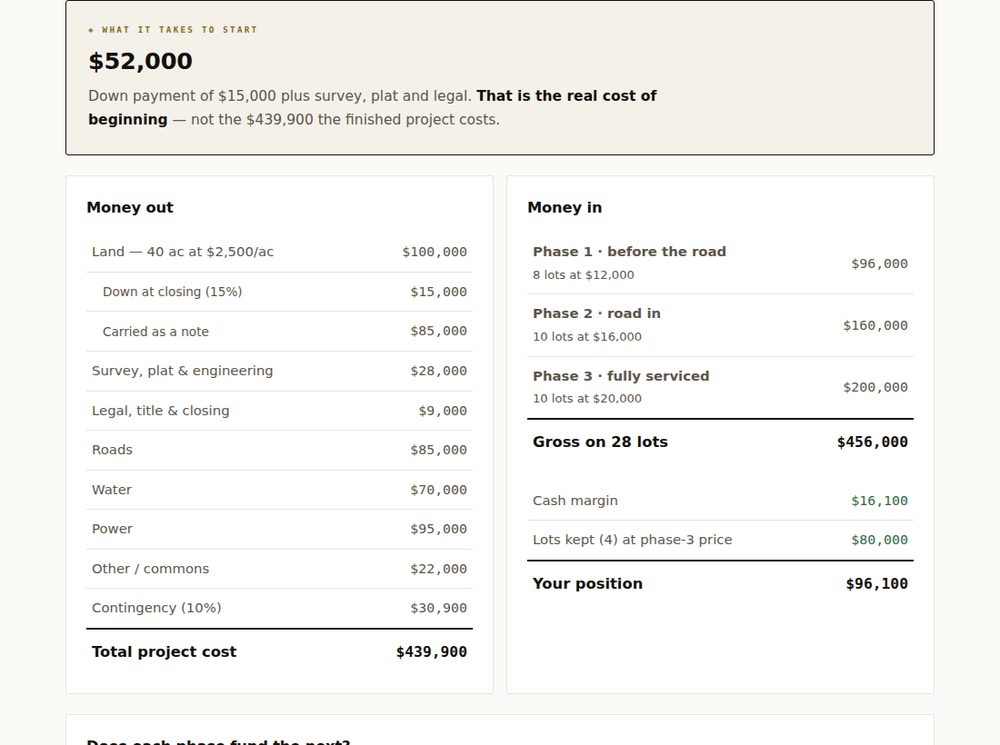
08Budget and phased development
Scope, estimation, contingency, and phasing so that phase one funds phase two rather than your savings doing it.
Phasing calculator
09Four real case studies
The Hereafter 460, Hereafter Farms Phase I, 40 Acres & a Well, and Plan X Pittsburgh — with the numbers and what we would do differently.
Real projects